
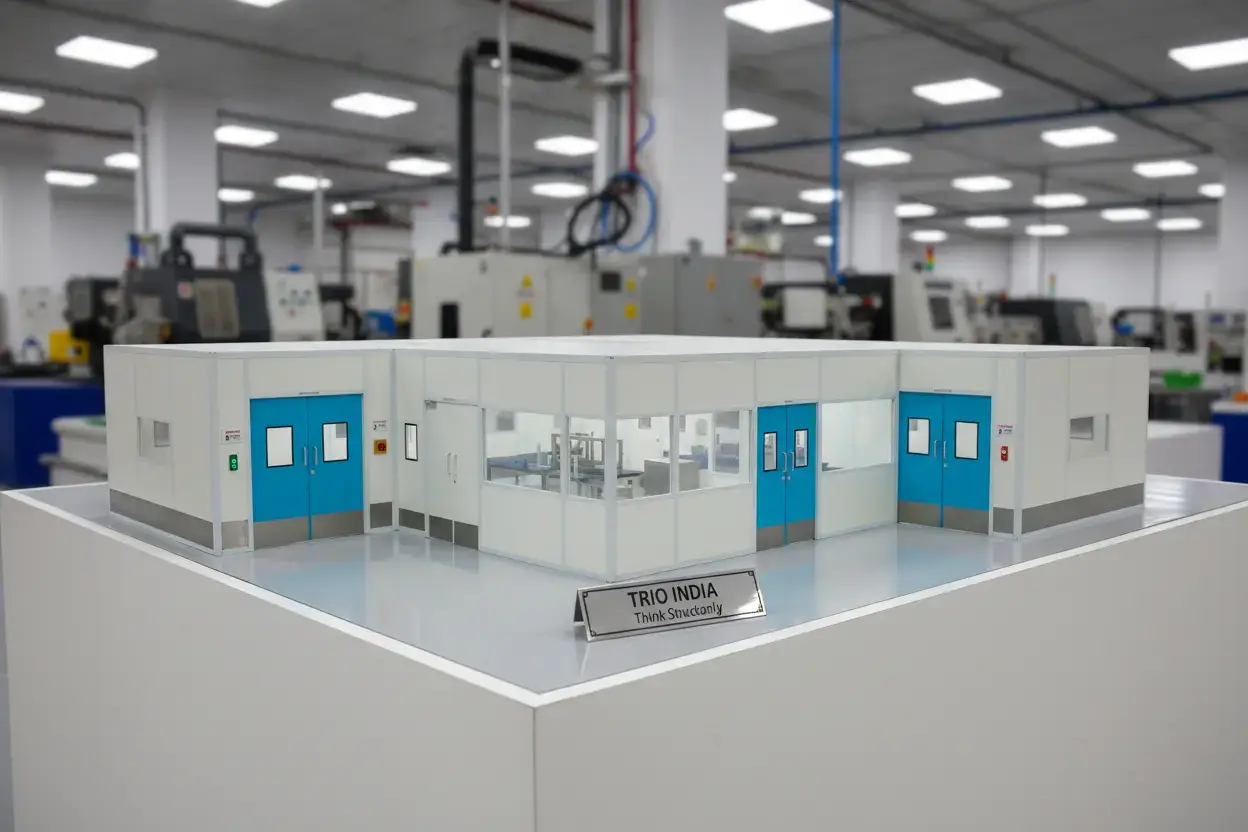
Selecting the wrong cleanroom type can lead to project delays, high costs, and limited scalability.
Understanding the key differences between modular cleanroom benefits and traditional cleanroom construction ensures long-term value and adaptability.
Traditional cleanrooms use conventional materials like brick, drywall, or concrete.
They’re permanent, require extensive civil work, and often take months to complete. Changes or expansions later can be costly and time-consuming.
Modular cleanrooms are built using pre-engineered wall and ceiling panels, cleanroom doors, and accessories.
Components are fabricated off-site and assembled quickly, providing a plug-and-play clean environment that can grow or move with your business.
 Fast installation – up to 40–50% quicker than traditional builds. Flexible and scalable – expand, relocate, or reconfigure easily. Cost-efficient long term – less downtime and rework. High compliance – built to meet ISO 14644, GMP, and FDA standards. Sustainable – reusable panels reduce material waste.
 Long build times and high on-site labor. Permanent and difficult to modify. Greater maintenance and utility disruption.
A clear cleanroom cost comparison reveals that modular systems may seem costlier upfront but save money in the long run through lower installation time, reduced downtime, and reusability.
| Aspect | Traditional Cleanroom | Modular Cleanroom |
|---|---|---|
| Construction Time | 4–8 months | 1–3 months |
| Flexibility | Low | High |
| Maintenance | Complex | Easy access panels |
| Future Expansion | Costly | Plug-in extensions |
| Total Lifecycle Cost | High | 20–25 % lower overall |
Modular cleanrooms excel in adaptability. Their interchangeable panels, pre-wired systems, and walkable ceilings make upgrades simple. They support industries where technology and standards evolve fast — from pharma to semiconductors.
Learn more about Trio India’s Modular Cleanroom Solutions or explore our
Fire-Rated Door Systems for comprehensive turnkey projects.
The verdict in the modular vs traditional cleanrooms debate depends on your project’s goals.
For most modern facilities seeking efficiency, flexibility, and long-term value, **modular cleanrooms** are the smart choice.
Traditional structures still serve specific, permanent installations — but modular technology is redefining what’s possible.
Contact Trio India today to discuss your project and discover a tailor-made flexible cleanroom solution that fits your budget and timeline.


